Buying premium shilajit should feel reassuring, not like a gamble. Yet the supplement aisle and the average online marketplace are crowded with jars that all make the same promises: "pure," "Himalayan," "Gold Grade," "high potency." The label tells you almost nothing, and the price tells you even less. So how do you actually separate a genuinely high-quality resin from an overpriced lookalike or a contaminated knockoff?
This guide answers exactly that. Instead of vague reassurances, you'll get the specific, checkable signals quality-minded buyers use: fulvic acid content, sourcing altitude, resin versus powder versus capsules, third-party lab testing and Certificates of Analysis (COAs), heavy-metal screening, and the sensory cues that hint at authenticity, plus a grading table, red flags, and a pre-purchase checklist. By the end, you should be able to evaluate any shilajit product, including ours, on the merits.
What "Premium Shilajit" Actually Means
Shilajit is a sticky, tar-like substance that seeps from rock crevices in high mountain ranges, most famously the Himalayas. Over long periods, plant and microbial matter is compressed under pressure and temperature into a mineral-rich exudate that's naturally abundant in fulvic acid, humic substances, and trace minerals. As a dietary supplement, it's traditionally used to support energy, stamina, and overall vitality, and modern research has begun exploring those uses.
The word "premium," though, isn't regulated, so anyone can print it. What makes shilajit genuinely high quality comes down to three measurable pillars:
- Composition — how much fulvic acid it contains and whether its mineral profile is intact.
- Purity — whether it's free of heavy metals, microbes, and fillers, verified by independent testing.
- Form and processing — whether it's a true purified resin or a diluted powder or capsule.
A product that scores well on all three is worth a premium price; one that leans on marketing language while skipping lab testing usually isn't. The sections below break each pillar down so you can judge for yourself.
Fulvic Acid: The Single Most Important Quality Metric
Fulvic acid is the compound most closely associated with shilajit's traditional benefits. It's thought to act as a natural carrier molecule, and research suggests it plays a role in how the body interacts with the minerals shilajit provides. Because it's both the active highlight and difficult to fake, fulvic acid percentage is the closest thing the category has to a quality score.
The nuance most brands gloss over: a high fulvic acid percentage only means something if it's verified by an accredited third-party lab. A number printed on a label with no COA behind it is just a claim, so your next question should always be, "Can I see the test that proves it?"
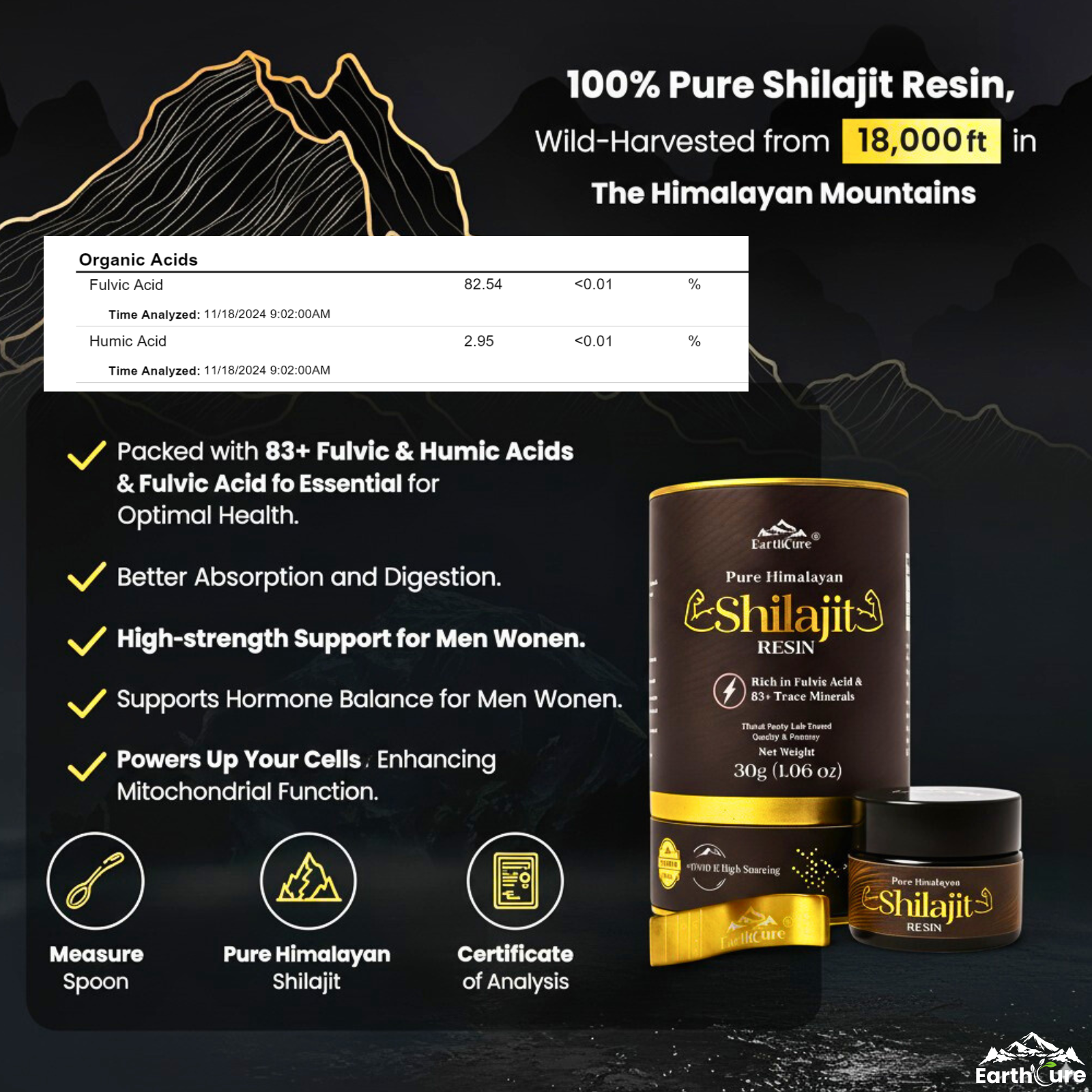
For reference, the EARTHCURE™ resin is tested at 82% fulvic acid, which places it in the Gold Grade tier described in the grading table further down. We'll return to how that's verified in the lab-testing section.
Why Percentage Alone Isn't the Whole Story
Two products can list similar fulvic acid numbers and still differ in quality. Watch for these distinctions:
- Fulvic acid vs. "fulvic + humic" blends. Some labels combine the two to inflate a single figure. They're related but not identical; ask which number is being reported.
- Testing method matters. Different lab methods can yield different fulvic readings. A reputable COA names the method used.
- Spiking. Cheap products are occasionally cut with isolated fulvic or humic powders to hit a marketing number while lacking shilajit's broader mineral profile. This is one reason purity testing matters as much as the headline percentage.
Sourcing and Altitude
Authentic shilajit is associated with high-altitude mountain environments, and elevation is often used as shorthand for quality. Higher, more remote sources are generally prized because the formation conditions and relative lack of industrial pollution tend to favor a cleaner, more concentrated exudate. Single-origin material, traceable to one region rather than blended from many unknown sources, also makes consistency and testing more meaningful.
That said, be skeptical of oddly precise altitude claims with no way to verify them; "high-altitude Himalayan" backed by lab results beats a hyper-specific number with no documentation. EARTHCURE™ uses single-origin, high-altitude Himalayan resin, and the part you can actually verify, its purity and composition, is documented on the COA.
Resin vs. Powder vs. Capsules
Form is one of the most practical quality signals, because it strongly influences how easy it is to dilute a product.
| Form | Typical purity | Fillers likely? | Notes |
|---|---|---|---|
| Resin | Highest | Rare in quality brands | The traditional form; sticky, concentrated, easy to dose by sight |
| Powder | Variable | Common | Easy to cut with maltodextrin, ash, or fillers; quality ranges widely |
| Capsules | Variable | Common | Convenient, but you can't inspect the contents; often powder-based |
Resin is generally considered the gold standard because it's closest to the raw, purified material and hardest to dilute without it being obvious. Powders and capsules aren't automatically bad, but they're far easier to bulk out with cheap fillers, and you lose the ability to inspect color, texture, and dissolution yourself. With those forms, third-party testing becomes even more essential.
EARTHCURE™ is a pure resin with no powders, capsules, or fillers, which is part of why the visual and physical authenticity cues below are usable in the first place.
Third-Party Lab Testing and COAs
If you remember one thing from this guide, make it this: independent lab testing is the difference between a trustworthy supplement and a hopeful guess. Shilajit forms in the ground, so contamination isn't a hypothetical, and self-reported claims from a seller aren't verification.
A Certificate of Analysis (COA) is the document that backs everything up. A meaningful COA generally includes:
- ✅ The name of an independent, accredited laboratory (not just "tested in-house")
- ✅ A heavy-metal panel with actual results for lead, arsenic, mercury, and cadmium
- ✅ Fulvic acid content, with the testing method noted
- ✅ Microbial / contaminant screening
- ✅ A batch or lot number and a recent date that you can tie to the product you're buying
Be wary of a COA you can't actually see, one with the lab name redacted, or one that's years old with no batch reference. To go deeper on reading and interpreting these documents, see our companion guide on why lab-tested shilajit matters.
How EARTHCURE™ Handles Testing
EARTHCURE™ resin is third-party lab tested in the USA, with a COA confirming 82% fulvic acid and non-detect heavy metals. Testing in the USA specifically matters because imported supplements don't all face the same independent scrutiny, and a domestic accredited lab gives buyers a clearer, verifiable paper trail.
Heavy-Metal Screening: The Safety Non-Negotiable
Because shilajit is a mineral-rich geological material, screening for toxic heavy metals isn't optional, it's the most important safety step in the entire category. The metals to check on any report are lead, arsenic, mercury, and cadmium. The 2014 safety review by Stohs (Phytotherapy Research) emphasized that purified, properly processed shilajit is generally well tolerated, while crude or unprocessed material is exactly where contamination concerns arise.
That's why "raw" or "unprocessed" is not a virtue here, despite how natural it sounds in marketing; proper purification removes contaminants. The combination you want is purified material and a current COA showing heavy metals at non-detect or safely low levels. If a seller can't provide that, the safe assumption is that the testing wasn't done.
Visual, Physical, and Taste Authenticity Cues
Lab data is the gold standard, but once a quality resin is in your hands there are sensory checks that help confirm you received what you paid for. These cues are most reliable for resin; they're far harder to apply to powders and capsules.
What Genuine Resin Tends to Look and Feel Like
- Color: deep brownish-black to black, often with a glossy, tar-like sheen.
- Temperature response: softens and becomes pliable with warmth (body heat or a warm room) and firms up when cold. A resin that stays rock-hard regardless of temperature, or stays runny, is suspect.
- Dissolving: dissolves in warm (not boiling) water, typically into a golden-brown to reddish-brown solution, without leaving gritty sand or chalky sediment. Cloudy residue or insoluble grit can signal fillers.
- Smell and taste: earthy and mineral-like, reminiscent of wet soil or stone, with a characteristically bitter taste. A strongly chemical, perfumed, or artificially sweet profile is a warning sign.
Treat these as supporting evidence, not proof. Sensory checks can flag an obvious fake, but they can't measure fulvic acid percentage or detect heavy metals, only a lab can do that. Use cues and COAs together. Our deep-dive on how to spot fake shilajit walks through more of these at-home tests in detail.
Shilajit Quality Grading at a Glance
The grading language you'll see ("Gold," "Silver," and so on) is industry shorthand rather than an official certification, but it's a useful framework when anchored to verifiable factors. Use this table as a quick mental model, then verify the specifics against a COA.
| Quality factor | Gold Grade (premium) | Mid grade | Low grade |
|---|---|---|---|
| Fulvic acid | ~80%+ (lab-verified) | ~50–79% | Below ~50% or unstated |
| Form | Pure resin | Resin or powder | Powder/capsules with fillers |
| Third-party testing | Accredited, with shareable COA | Limited or in-house | None or undisclosed |
| Heavy metals | Non-detect / safely low, documented | Sometimes tested | Untested/unknown |
| Sourcing | Single-origin, high altitude | Mixed sources | Undisclosed origin |
For a closer comparison of the tiers and what actually separates them in practice, see Gold Grade vs. regular shilajit.
Red Flags of Cheap or Fake Shilajit
Some warning signs are reliable enough that any single one justifies pausing the purchase:
- 🚩 No COA, or a COA you can't actually view. The most important red flag of all.
- 🚩 "Raw" or "unprocessed" sold as a selling point, with no heavy-metal testing to back up safety.
- 🚩 Powder or capsules with a long filler list (or an undisclosed "proprietary blend").
- 🚩 Prices that are far below the category norm. Genuine high-altitude, purified, lab-tested resin has real costs; a suspiciously cheap jar usually cut a corner somewhere.
- 🚩 No traceable origin and no batch/lot number.
- 🚩 Sensory mismatches: chemical or perfumed smell, artificial sweetness, gritty residue that won't dissolve, or a resin that ignores temperature changes.
- 🚩 Only vague benefit hype ("miracle," "cure-all") with zero substantiation. Strong disease claims are both a quality and a compliance red flag.
Why EARTHCURE™ Meets a Premium Standard
We built EARTHCURE™ around the same criteria this guide recommends, so you can verify our claims rather than take them on faith:
- Composition: Gold Grade pure resin tested at 82% fulvic acid.
- Purity: USA third-party lab tested with a COA showing non-detect heavy metals.
- Form: single-origin, high-altitude Himalayan pure resin, with no powders, capsules, or fillers.
- Packaging: a 30g amber-glass jar (about $39.99), since amber glass helps shield the resin from light during storage.
You can review the details on our product page or buy directly on Amazon. EARTHCURE™ is made by AUH Partners LLC, and you can also find us on Facebook.
Your Pre-Purchase Quality Checklist
Before you buy any shilajit, premium or otherwise, run through this list. A genuinely high-quality product should let you check every box:
- ✅ Form is clearly stated (ideally pure resin), with fillers either absent or fully disclosed.
- ✅ Fulvic acid percentage is listed and backed by a viewable COA.
- ✅ The COA names an accredited, independent lab and shows a recent date plus a batch/lot number.
- ✅ Heavy metals (lead, arsenic, mercury, cadmium) are tested and reported as non-detect or safely low.
- ✅ Origin is disclosed (single-origin and high-altitude are good signs).
- ✅ Pricing is in a believable range for tested, purified resin, not implausibly cheap.
- ✅ Claims are measured and honest, supporting wellness rather than promising to cure disease.
- ✅ The seller is transparent and reachable, with a real company behind the brand.
If you're shopping domestically and want to understand import, labeling, and where-to-buy considerations, our guide to buying shilajit in the USA is a useful next read.
Frequently Asked Questions
Q: What is the most important factor when judging shilajit quality?
A: A lab-verified fulvic acid percentage paired with a clean heavy-metal screening is the most telling combination. Fulvic acid reflects composition, the heavy-metal panel reflects safety, and a third-party COA ties both to reality. A high number with no test behind it shouldn't carry much weight.
Q: Is resin really better than powder or capsules?
A: Resin is generally considered the highest-quality form because it's closest to the purified raw material and hardest to dilute without it being obvious. Powders and capsules can still be good, but they're easier to cut with fillers and you can't inspect them yourself. If you choose those forms, lean even more heavily on third-party testing.
Q: How do I read a Certificate of Analysis (COA)?
A: Look for an accredited independent lab name, a recent date, and a batch or lot number you can match to your product. Confirm it reports a heavy-metal panel (lead, arsenic, mercury, cadmium) and a fulvic acid figure with the method noted. If the COA is unavailable, redacted, or years old with no batch reference, treat that as a red flag.
Q: Does a higher altitude guarantee better shilajit?
A: High-altitude, single-origin sourcing is a positive signal, but not a guarantee on its own, and altitude claims are easy to exaggerate. What ultimately matters is verifiable purity and composition, so treat altitude as supporting context and let the lab results do the heavy lifting.
Q: Why does premium shilajit cost more than cheap alternatives?
A: Genuine high-quality resin reflects real costs: remote sourcing, proper purification, and independent lab testing all add up. A suspiciously low price usually means one of those steps was skipped, most often the testing. A fair price for a verified product is generally better value than a cheap jar you can't trust.
Q: Can I tell if shilajit is real just by looking at or tasting it?
A: Sensory cues like a glossy dark resin, an earthy smell, a bitter taste, and clean dissolving in warm water can help you flag an obvious fake. But they can't measure fulvic acid or detect heavy metals, so they're supporting checks rather than proof. Always pair them with a third-party COA.
Q: Is shilajit safe and well tolerated?
A: Purified, properly tested shilajit is generally well tolerated, and the Stohs 2014 safety review supports that for purified material. The bigger risk comes from crude or untested products that may contain contaminants, which is exactly why heavy-metal screening matters. As with any supplement, consult a qualified healthcare professional before use, especially if you're pregnant, nursing, taking medication, or managing a health condition.
Key Takeaways
Judging shilajit quality doesn't require insider knowledge, just a willingness to ask for proof. Prioritize a lab-verified fulvic acid percentage, a clean heavy-metal screening, a pure resin form, transparent sourcing, and a COA you can actually see. Use sensory cues as a helpful secondary check, and treat missing test data as the loudest red flag of all. Do that, and "premium" stops being a marketing word and becomes something you can verify.
If you'd like a resin that already meets these standards, EARTHCURE™ Gold Grade Pure Himalayan Shilajit is third-party lab tested at 82% fulvic acid with non-detect heavy metals. Explore the details on our product page or order on Amazon.
Medical Disclaimer: This article is for informational purposes only and is not medical advice. EARTHCURE™ shilajit is a dietary supplement and is not intended to diagnose, treat, cure, or prevent any disease. These statements have not been evaluated by the FDA. Consult a qualified healthcare professional before use, especially if you are pregnant, nursing, taking medication, or have a medical condition.