If you have ever reached for a third coffee just to push through an afternoon of email, you already understand why shilajit cognitive support has become such a popular topic. People want sharper focus and steadier mental energy from something that works alongside their biology rather than whipping it into a temporary frenzy.
Shilajit is a mineral-rich resin that seeps from rock crevices in high mountain ranges like the Himalayas. Used in traditional Ayurvedic practice for centuries, its modern interest centers on two of its most studied components: fulvic acid and a class of small molecules called dibenzo-alpha-pyrones (DBPs). Both are explored for their antioxidant behavior, the thread that connects shilajit to conversations about the brain.
This guide walks through what is actually known about shilajit and cognition, what is still preliminary, and how people use it for daytime focus. Throughout, the goal is honesty over hype: shilajit is a dietary supplement, not a treatment, and the most useful expectations are realistic ones.
What "Cognitive Support" Actually Means Here
It helps to define terms before diving in, because "brain support" can mean very different things to different people.
When we talk about cognitive support in the context of a supplement like shilajit, we are talking about things like:
- Day-to-day mental clarity and the absence of "brain fog"
- The ability to sustain attention on a task without constant restarts
- Steady mental energy that does not spike and crash
- General support for healthy aging, framed as wellness rather than disease prevention
What we are explicitly not talking about is treating, curing, or preventing any medical condition. You will see shilajit discussed alongside research into serious brain conditions, and it is worth understanding that this is exploratory scientific curiosity, not evidence that a resin in your morning water is a medical intervention. We will come back to this distinction in the research section because it matters.
Fulvic Acid, DBPs, and the Antioxidant Angle
The most concrete reason researchers connect shilajit brain discussions to fulvic acid and DBPs is oxidative stress.
Why oxidative stress comes up so often
Your brain is metabolically expensive: it makes up a small fraction of your body weight but consumes a large share of your daily energy, and that energy production generates reactive byproducts. An imbalance between these reactive molecules and your body's antioxidant defenses is called oxidative stress, a normal area of interest in aging and cellular-health research, including the nervous system.
Where shilajit's components fit
Fulvic acid is a naturally occurring compound formed as organic matter breaks down over very long timescales, and it is a major contributor to shilajit's character. DBPs are small molecules that have drawn attention for antioxidant behavior in lab settings. Stohs (2014), in a review in Phytotherapy Research, discussed shilajit's safety profile and bioactive constituents including fulvic acid. The general framing in the literature is that these compounds are interesting because of how they behave as antioxidants.
A simple way to hold this in your head:
| Component | What it is | Why it appears in brain discussions |
|---|---|---|
| Fulvic acid | A compound formed from long-term breakdown of organic matter | Studied for antioxidant behavior and as a carrier of minerals |
| Dibenzo-alpha-pyrones (DBPs) | Small molecules native to shilajit | Investigated for antioxidant activity in lab settings |
| Trace minerals | Naturally present in the resin | Cofactors the body uses in countless processes |
Keep in mind that antioxidant activity observed in a lab is a long way from a proven cognitive benefit in a healthy person. It is a plausible mechanism and a reason for interest, not a finished conclusion.
The Carrasco-Gallardo Review and Why It Is Discussed Carefully
Any honest article about shilajit memory has to address the study people most often cite, and it has to do so responsibly.
What the review actually was
Carrasco-Gallardo and colleagues published a paper in 2012 in the International Journal of Alzheimer's Disease discussing shilajit and its fulvic acid component, and framing a "procognitive" interest. In plain terms, the authors laid out why shilajit's constituents were a reasonable thing for scientists to investigate further in the context of cognition. It was an exploratory, hypothesis-generating discussion.
What it was not
This is the important part. That review is not evidence that shilajit prevents, treats, or slows Alzheimer's disease or dementia, and it does not establish shilajit as a therapy for anyone. Exploratory scientific interest is the beginning of a long research process, and many promising early ideas never pan out in rigorous human trials. Anyone who tells you a supplement prevents a neurodegenerative disease is going far beyond the evidence, and that is not a claim EarthCure makes.
So when you read that shilajit has "procognitive interest" in the literature, the accurate translation is: researchers found it interesting enough to study, and the questions remain open. That is genuinely worth knowing, and genuinely limited.
A note on other shilajit research
For broader context, Pandit et al. (2016), in Andrologia, examined shilajit in male reproductive health rather than cognition. It is worth mentioning only to show that shilajit research spans several topics, and that the cognitive literature specifically is still early-stage. For a wider look at the evidence, see our overview of the science-backed benefits of shilajit.
Mitochondria, Mental Energy, and the "Clarity" People Describe
Beyond antioxidants, the other mechanism that comes up in shilajit focus conversations is cellular energy.
The neuron energy connection
Neurons are demanding cells that rely heavily on mitochondria, the structures inside cells that produce usable energy as ATP. Several discussions of shilajit propose that supporting mitochondrial efficiency could be relevant to how energized and clear-headed someone feels. This is a mechanistic hypothesis rather than a proven cognitive claim, but it lines up with a common subjective report.
What people commonly report
Many users describe their experience with shilajit not as a sudden jolt but as a smoother baseline:
- A sense of steadier mental energy through the day
- Less of the heavy "afternoon slump" feeling
- Mental clarity that feels calm rather than wired
These are anecdotal reports, and individual responses vary widely. They are useful for setting expectations, not as guarantees. If you are weighing this against your usual cup of coffee, our comparison of shilajit energy versus caffeine digs into the practical differences.
Shilajit as a Traditional Adaptogen for Focus and Clarity
Long before laboratory analysis, shilajit had a place in traditional practice, and that history is part of why it is associated with focus today.
The adaptogen framing
In traditional use, shilajit is often described as a rasayana, or rejuvenating substance, and it sits within the broader modern category people call adaptogens, substances traditionally used to help the body cope with stress. Because chronic stress and poor sleep are two of the biggest real-world enemies of focus, that traditional emphasis on resilience maps neatly onto why people try shilajit for mental clarity.
Holding tradition and science side by side
✅ Tradition tells us how shilajit has been used and valued for a very long time ✅ Modern research tells us which mechanisms are plausible and worth studying ❌ Neither one, on its own, proves that shilajit will sharpen your focus on demand
The most grounded view treats traditional use as meaningful context and modern science as the slowly developing verdict. To understand the substance itself in more depth, our pure Himalayan shilajit guide covers what it is and where it comes from.
How to Use Shilajit for Daytime Focus
If you want to try shilajit specifically for mental clarity during your working hours, a few practical habits make the experience more consistent.
Timing
Because many people find shilajit gently energizing, mornings or early afternoons tend to suit a focus goal better than late evenings. Taking it earlier in the day also means any subtle energy effect is working with your schedule rather than against your wind-down. We cover this in detail in our guide to the best time to take shilajit.
A simple resin routine
With a pure resin like EarthCure, the typical approach is:
- Scoop a small portion, roughly the size of a grain of rice to a pea, using the included tool or a clean spoon.
- Dissolve it in warm (not boiling) water, tea, or another beverage.
- Drink it down; many people pair it with their morning routine for consistency.
Follow the dosage guidance on your product, and start on the lower end so you can see how you respond. For a fuller walkthrough, see how to use shilajit.
Consistency over intensity
Shilajit is not a stimulant you take for an instant hit. People who report the clearest benefits tend to use it daily and consistently for several weeks, paying attention to how they feel rather than expecting a dramatic same-day change.
Stacking and Lifestyle: The Real Drivers of Focus
It would be dishonest to suggest a supplement is the main lever for cognition. The biggest, most reliable factors are unglamorous, and shilajit works best as a small addition on top.
Lifestyle fundamentals that genuinely move the needle
| Factor | Why it matters for focus |
|---|---|
| Sleep | Memory consolidation and next-day attention depend heavily on quality sleep |
| Exercise | Physical activity supports healthy blood flow and overall brain health |
| Nutrition | Stable blood sugar and adequate nutrients underpin steady mental energy |
| Stress management | Chronic stress is one of the most consistent disruptors of clear thinking |
| Hydration | Even mild dehydration can make focus feel harder than it should |
If sleep and stress are not handled, no supplement will paper over the gap. Shilajit is the seasoning, not the meal.
A sensible word on "stacking"
People sometimes combine shilajit with other wellness staples like omega-3s or other traditional botanicals. If you choose to combine supplements, do it thoughtfully and ideally with input from a healthcare professional, especially if you take medication. More products stacked together is not automatically better, and simpler routines are easier to evaluate honestly.
Setting Realistic Expectations
Mismatched expectations are the number-one reason people feel let down by any supplement, so here is a fair summary of where things stand:
- The cognitive story rests largely on mechanisms (antioxidant behavior, cellular energy) and early, exploratory research, not on settled proof of a focus or memory benefit in healthy adults.
- Subjective reports of steadier energy and clarity are common, but anecdotal and variable.
- Any benefit is more likely to feel like a gentle, cumulative shift than a dramatic transformation.
- It is not a substitute for sleep, exercise, medical care, or treatment of any condition.
Expect a supportive supplement that fits into an already-healthy routine and you set yourself up for a fair evaluation. Expect a miracle nootropic and no product will meet that bar.
Why EARTHCURE™ for Cognitive Wellness
If you have decided to try shilajit for general focus and clarity, quality and purity matter more here than almost anywhere, because anything you take daily should be clean and verifiable.
EARTHCURE™ Pure Himalayan Shilajit Resin is built around exactly that:
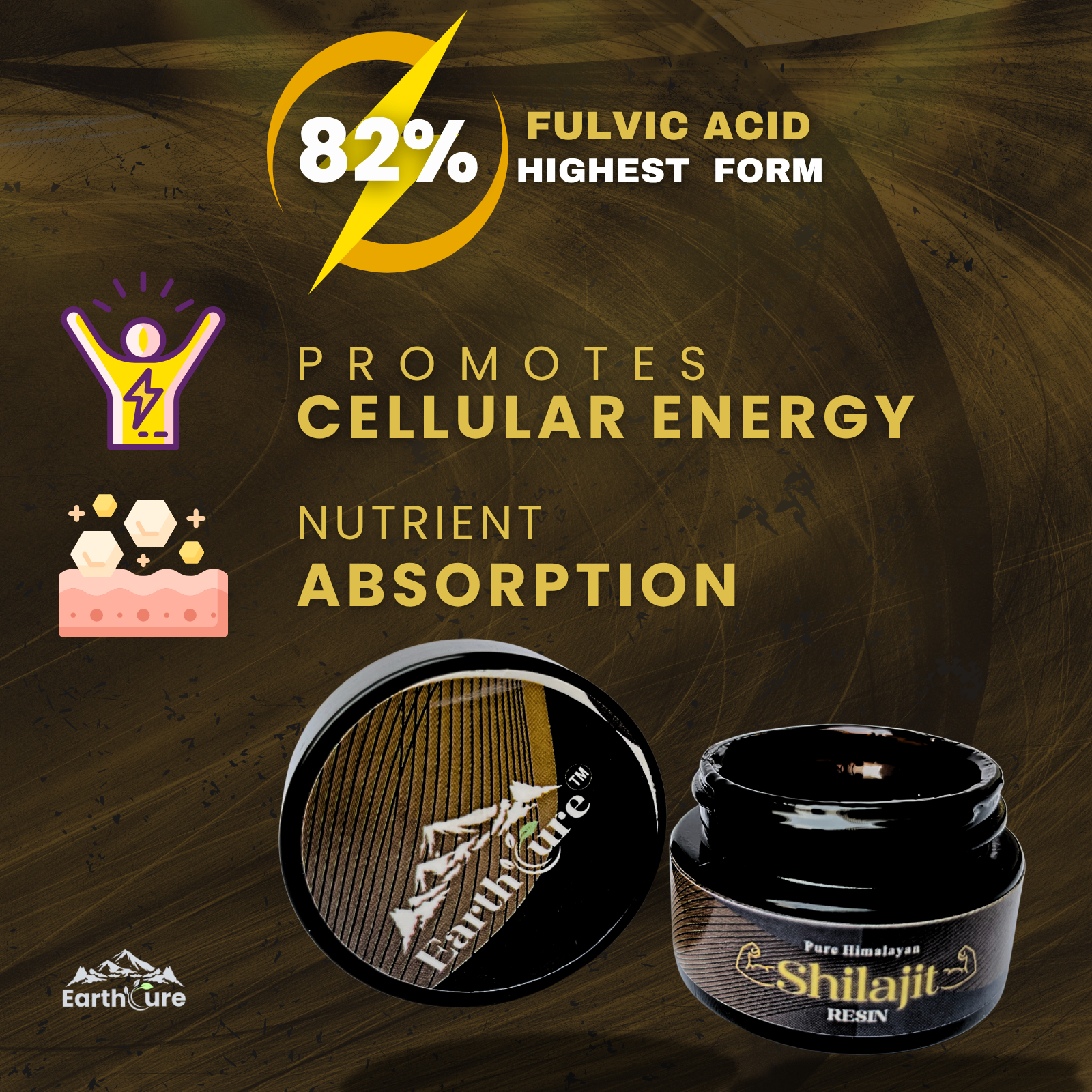
- Pure resin, nothing else — a 30g amber-glass jar of single-origin, high-altitude Himalayan resin, with no powders, capsules, or fillers.
- 82% fulvic acid, "Gold Grade" — a high concentration of the compound most discussed in shilajit's antioxidant story.
- USA third-party lab tested with a COA — independent testing with a Certificate of Analysis, and non-detect results for heavy metals, so purity is documented rather than assumed.
- Honest positioning — it is offered as a dietary supplement to support a healthy lifestyle, never as a treatment.
You can learn more on the EarthCure product page or order the resin directly on Amazon. EarthCure is made by AUH Partners LLC.
Safety and When to Talk to a Professional
Shilajit is generally well tolerated by healthy adults when used as directed, and the Stohs (2014) review discussed its favorable safety profile when sourced and purified properly. That last part is the catch: purity is everything, which is why third-party testing and non-detect heavy-metal results are not a luxury but a baseline requirement.
A few sensible cautions:
- Start with a small amount to assess your individual tolerance.
- Choose only lab-tested, contaminant-free resin from a transparent source. Unverified shilajit can contain heavy metals or adulterants.
- Talk to a qualified healthcare professional before starting, especially if you are pregnant, nursing, taking any medication, or managing a medical condition.
- Stop use and seek advice if you experience any adverse reaction.
Frequently Asked Questions
Q: Does shilajit actually improve memory and focus?
A: The honest answer is that the evidence is preliminary. Shilajit is studied for antioxidant and cellular-energy mechanisms that are plausibly relevant to cognition, and many users report steadier mental clarity, but high-quality proof of a memory or focus benefit in healthy adults is still limited. Treat it as a supportive supplement, not a guaranteed enhancer.
Q: Can shilajit prevent or treat Alzheimer's or dementia?
A: No. Some researchers have expressed exploratory interest in shilajit's components in the context of cognition, but that is early-stage scientific curiosity, not evidence of any preventive or therapeutic effect. Shilajit is a dietary supplement and is not intended to diagnose, treat, cure, or prevent any disease. Neurodegenerative conditions require qualified medical care.
Q: What is fulvic acid, and why is it linked to the brain?
A: Fulvic acid is a compound formed as organic matter breaks down over very long timescales, and it is one of shilajit's signature constituents. It draws attention mainly for its antioxidant behavior in laboratory settings, which is why it appears in discussions about oxidative stress and brain health. That mechanistic interest is promising but not the same as a proven cognitive benefit.
Q: When should I take shilajit for daytime focus?
A: Most people find mornings or early afternoons work best, since shilajit can feel gently energizing and earlier timing keeps it from interfering with sleep. Dissolve a small, rice-grain-to-pea-sized portion of resin in warm water and take it consistently. See our guide to the best time to take shilajit for more detail.
Q: How long until I might notice anything?
A: Shilajit is not an instant stimulant, so changes tend to be subtle and cumulative rather than immediate. People who report benefits usually use it daily and consistently for several weeks while keeping an eye on how they feel. Individual responses vary, and some people notice little change, which is a normal outcome for any supplement.
Q: Is shilajit safe to take every day?
A: For healthy adults, pure shilajit used as directed is generally well tolerated, and reviews of its constituents describe a favorable safety profile when it is properly sourced and purified. The key is purity: only use lab-tested, contaminant-free resin with documented non-detect heavy-metal results. Consult a healthcare professional before daily use if you are pregnant, nursing, on medication, or have a medical condition.
Q: Can I combine shilajit with coffee or other supplements?
A: Many people do pair shilajit with their usual coffee or other wellness staples, and shilajit's calmer, non-jittery character is part of why. That said, more is not automatically better, and combining supplements is best done thoughtfully with professional input, particularly if you take medication. Keeping your routine simple also makes it easier to judge what is actually helping.
Key Takeaways
Shilajit's connection to the brain is genuinely interesting and genuinely early. Its fulvic acid and DBP content are studied for antioxidant behavior, its mineral richness supports a role in cellular energy, and its long traditional use as an adaptogen is why people associate it with focus and clarity. The Carrasco-Gallardo (2012) review captured real scientific curiosity about cognition, but it is exploratory, not proof, and shilajit should never be framed as a way to prevent or treat any disease.
Used realistically, shilajit is a clean daily supplement that fits on top of the things that truly drive cognition: sleep, exercise, nutrition, and stress management. If you want to try it, purity matters most.
Explore EARTHCURE™ Pure Himalayan Shilajit Resin for single-origin, lab-tested Gold Grade resin, or pick it up directly on Amazon and make it part of a well-rounded routine.
Medical Disclaimer: This article is for informational purposes only and is not medical advice. EARTHCURE™ shilajit is a dietary supplement and is not intended to diagnose, treat, cure, or prevent any disease. These statements have not been evaluated by the FDA. Consult a qualified healthcare professional before use, especially if you are pregnant, nursing, taking medication, or have a medical condition.